I have spent the better part of two decades making complex systems visible and understandable, first in infrastructure, then in monitoring, and eventually in the quieter work of writing and reflection. The through-line has always been the same.
Find the pattern, make it legible, and build something that holds.
I live in Western North Carolina with my wife Jamie and our three sons. This is home in the truest sense I have ever known the word.
Where It Started
I was born in Palm Beach, Florida in 1977 and grew up in South Florida — Palm Beach Gardens first, then the Naples and Bonita Springs area. My path into adulthood was not conventional. Diagnosed with Tourette's Syndrome at age 9, friction with school systems, and an early GED meant I was self-directing long before anyone handed me a job title or a career plan. What could have been a story about falling through cracks became something else: the first time I would take a broken path and build my own direction from it, a pattern I would repeat for decades.
Before technology became my profession, I worked difficult early jobs and built independence the hard way, including starting and running a pool cleaning business while feeding a growing interest in computers. That interest eventually became the pivot point.
The Technical Path
My path into technology was not linear. I left Florida for Oregon in the late 1990s chasing something more technical than South Florida was going to offer, landed at Intel Online Services doing technical support and training, and discovered that documentation, explanation, and systems thinking were durable strengths — the kind that outlast any single role.
After returning to Florida in early 2001, work in Naples introduced me to Linux in a professional setting, and that discovery was one of the clearest turning points in my career. For the first time, I was not a passive observer of software. I had agency, the ability to build what I needed, act on ideas no one had brought to market yet, and do it all with a barrier to entry so low that the only real limit was imagination. That realization reshaped everything. From there, I moved into increasingly hands-on infrastructure work — networks, servers, remote connectivity, custom Linux-based systems — and eventually into open-source consulting, helping businesses move away from rigid, vendor-locked technology stacks toward something more adaptable.
Monitoring, Observability, and Clarity
As the years went on, my career converged on a single question: how do you make something complex understandable before it hurts someone? Early work at Interop Technologies, defining and building distributed monitoring for mission-critical telecom infrastructure, gave the question its first real shape. Each role after that expanded the scope and maturity of the work, and monitoring became the defining thread of my professional life.
What made it the defining thread was not circumstance. I could never stop advocating for it. I saw what monitoring work made possible for every team it touched — stability, visibility, faster resolution — and I kept pushing until the organizations around me saw it too. It was never a single moment. It was years of making the case, proving the value, and refusing to let monitoring remain an afterthought.
In 2015, I joined Ingles Markets. What started as Unix and Linux engineering evolved over more than a decade into large-scale enterprise monitoring and observability, supporting critical infrastructure across stores, systems, and operational platforms. When monitoring became important enough to stand on its own, I built the team around it — holding the broader architecture and topology alongside the hands-on investigation of individual scripts and tools. Going from doing the work to leading the people who do it did not mean stepping back from the details. It meant holding both.
Today, I lead that team working with Splunk ITSI, Prometheus, Grafana, and OpenTelemetry. The tools change. The question does not.
Family and Geography
I met Jamie at two in the morning in a Starbucks drive-through. We both worked the overnight shift, and the connection was instant and lasting. From that point forward I structured my nights around her — my midnight lunch and my 2AM break both spent finding whatever minutes I could in her company. Those nightly visits became the thing I looked forward to most, and they became the beginning of everything that followed.
That relationship became the central thread of everything after it — marriage, fatherhood, and a series of work-driven moves across the country. Our three sons were each born in a different state across those chapters, Colorado, New York, and North Carolina, marking three different versions of us, still becoming who we are.
That motion settled in 2015 when we arrived in the Asheville area. Two years later, Jamie and I found a hidden, roughly two-acre property I named Woodhaven, and we knew immediately it was ours. What started as a house became something larger: a center of gravity, a family anchor, and a place where work, memory, hardship, and imagination all started to intertwine. Woodhaven has been tested by floods, by storms, by the ordinary weight of real life, but it has held, and so have we.
Hurricane Helene and What It Clarified
In late 2024, Hurricane Helene struck Western North Carolina and deeply disrupted life at Woodhaven. Loss, separation, damage, evacuation, recovery — all of it came at once. For a time, we had to abandon Woodhaven entirely, becoming refugees taken in by family in Florida, only to be forced to flee again as Hurricane Milton bore down behind us. Throughout it all, I continued supporting Ingles Markets, an organization just as devastated as the communities it served, but critical to providing food across several disaster-struck regions, while also holding my family together and helping my children navigate the trauma and loss unfolding around them.
After nearly sixty days, we returned to the still-devastated region, unlocked Woodhaven, and began the long process of picking up the pieces. The experience did not create the values I live by, but it clarified them in a way that nothing else had.
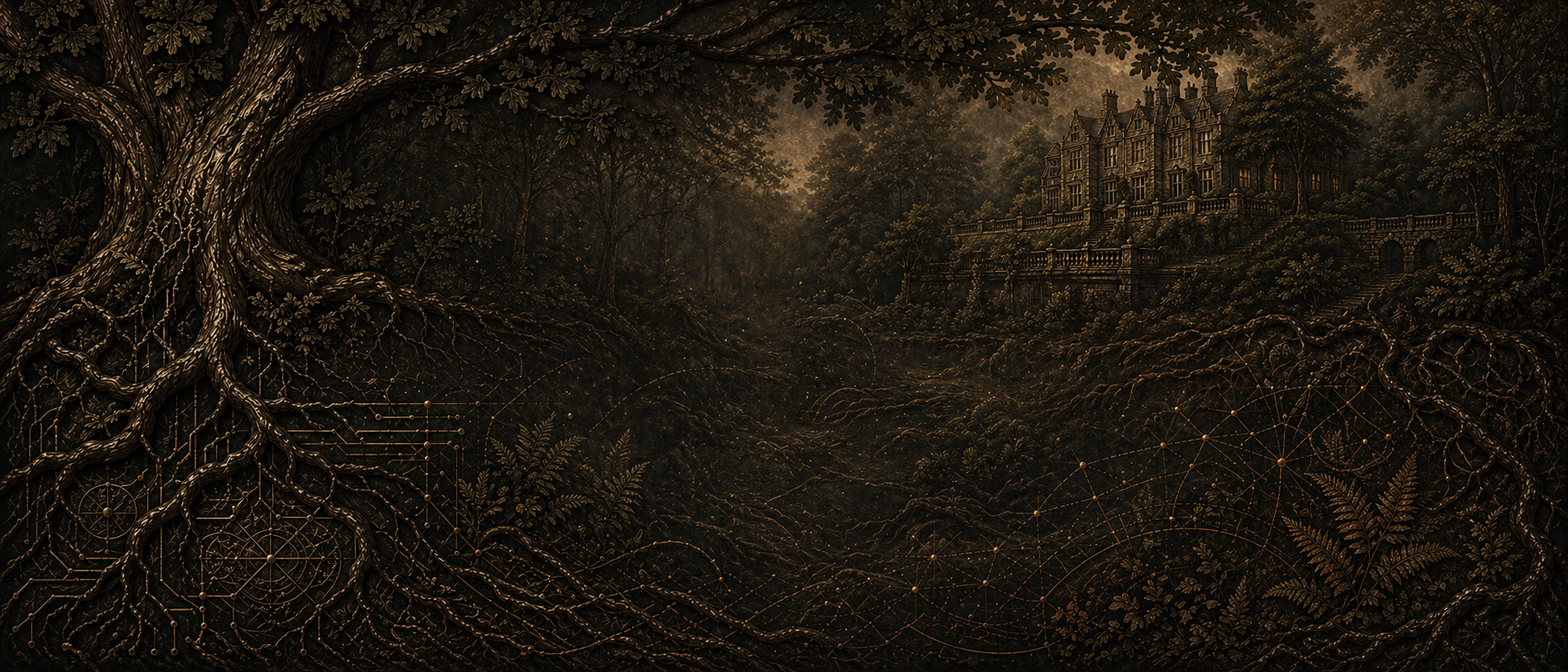
Woodhaven's motto, Per Tempestas, Radices — "through storms, roots" — was already true long before the storm arrived.
Writing and Inner Work
Although always central to my identity, in recent years the writing side of my life has moved closer to the surface. Fiction, essays, and philosophical inquiry have become part of the same practice that used to express itself entirely through documentation, infrastructure, and monitoring. The mediums are different, but the instinct is the same: make hidden structures visible, bring clarity to complexity, and turn internal patterns into something another person can see.
My practice starts before the house wakes up. A single light on, the rest dark and silent, a hot cup of coffee, sometimes a cat in my lap. I write from my own experience first because I know exactly how I would react. There is no guessing, no performing. If I put a character in a hospital room, I know what the fear tastes like. If I put them in a snowstorm, I know the specific frustration of watching someone find beauty in the thing that is terrifying you.
Writing is not recording. It is standing inside your own life and suddenly seeing it from a distance you did not have while living it.
The raw material is real: real births, real disasters, real arguments at two in the morning, real moments of grace that arrived without warning. A moment I thought was about survival turns out to be about trust. A gesture I thought was small turns out to be load-bearing. Some of it is too sharp to look at directly, so I have developed ways to wrap the worst of it — not to hide it, but to make it survivable for me and for the reader. When I write, I am not confessing. I am translating experiences that do not have clean language yet, and the writing is how I find the language.
Now
My life sits at the intersection of engineering, family, place, and meaning. I have spent decades building systems, and the older I get, the more those systems rhyme with everything else that matters — homes, relationships, teaching, stories, and the quiet structures that keep a life from collapsing under its own weight. I still work in observability. I still write. I still build. I am still following patterns.
The Pattern Beneath It
If there is a single drive underneath all of it — the monitoring work, the writing, the house in the woods, the decades of building things that hold — it is this: I need to take chaos and turn it into order. Not quiet it, not deny it, but make it legible. Something that can be understood, measured, weighed for risk, communicated, and accounted for. Something a person can stand inside of without losing their footing.
That drive is far older than my career. It started the year my nervous system began moving without my permission and kept going through every system that failed to make sense of a child who did not fit its shape. It shaped how I moved through broken institutions, disenfranchising politics, cultural noise, and the slow, accelerating complexity of a world that demands more of us while explaining less. Everywhere I looked, the systems we depend on were growing less intelligible at exactly the rate we were being asked to trust them more. I could not stop noticing that gap. I still cannot.
Monitoring was one answer to it. Writing is another. Woodhaven is a third.
They look like different pursuits, but they are the same instinct in different registers: find what is hidden, give it a shape that can be held, and leave behind something someone else can use to navigate. If anything I have built, written, or led has made a complex thing a little more understandable for someone standing in front of it, then the pattern has held, and the work has been worth it.